Framed Art Print Leutzes Washington Crossing the Delaware C1851 1
| Washington Crossing the Delaware | |
|---|---|
 | |
| Artist | Emanuel Leutze |
| Year | 1851 |
| Medium | Oil on canvas |
| Dimensions | 378.5 cm × 647.7 cm (149 in × 255 in) |
| Location | Metropolitan Museum of Art, New York, and Minnesota Marine Art Museum, Winona, Minnesota |
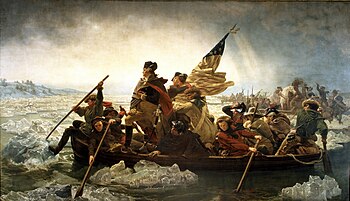
Washington Crossing the Delaware is the championship of three 1851 oil-on-sail paintings by the German-American artist Emanuel Leutze.
The paintings commemorate General George Washington's crossing of the Delaware River with the Continental Army on the nighttime of December 25–26, 1776, during the American Revolutionary War. That activity was the first move in a surprise attack and victory against Hessian forces at the Battle of Trenton in New Jersey on the morning of December 26.
The original was part of the collection at the Kunsthalle in Bremen, Frg, and was destroyed in a bombing raid in 1942, during World War II. Leutze painted 2 more versions, 1 of which is now in the Metropolitan Museum of Fine art in New York City. The other was in the West Wing reception surface area of the White Business firm in Washington, D.C., only in March 2015, was purchased and put on display at the Minnesota Marine Fine art Museum in Winona, Minnesota. In April, 2022 Christie'southward announced that the smaller painting volition be sold at auction in May, for a pre-sale approximate of $15 to $xx million.[1]
History [edit]

Emanuel Leutze grew up in America, so returned to Germany as an adult, where he conceived the idea for this painting during the Revolutions of 1848. Hoping to encourage Europe'south liberal reformers through the instance of the American Revolution, and using American tourists and fine art students as models and administration, among them Worthington Whittredge and Andreas Achenbach, Leutze finished the beginning painting in 1850. Simply after it was completed, the starting time version was damaged by fire in his studio,[ii] afterward restored, and acquired past the Kunsthalle Bremen. On September 5, 1942, during Globe War II, it was destroyed in a bombing raid by the Allied forces.[three]
The 2nd painting, a total-sized replica of the kickoff, was begun in 1850 and placed on exhibition in New York in October 1851. More than 50,000 people viewed it. The painting was originally bought by Marshall O. Roberts for $10,000 (at the time, an enormous sum. Approximately $350,000 in 2021). After changing ownership several times, it was finally donated to the Metropolitan Museum of Art past John Stewart Kennedy in 1897. Washington Rallying the Troops at Monmouth, Leutze'south companion slice to Washington Crossing the Delaware is displayed in the Heyns (Due east) Reading Room of Doe Library at the University of California, Berkeley.
The painting was lent at least twice in its history. In the early 1950s, it was part of an exhibition in Dallas, Texas. Then, beginning in 1952, it was exhibited for several years at the United Methodist Church building in Washington Crossing, Pennsylvania, not far from the scene of the painting. Today, it is on exhibition at the Metropolitan Museum of Art.
In January 2002, the painting was defaced when a former Metropolitan Museum of Art baby-sit glued a picture of the September eleven attacks to it. No major harm was caused to the painting.[iv]
The unproblematic frame that had been with the painting for over 90 years turned out not to be the original frame that Leutze designed. A photograph taken past Mathew Brady in 1864 was constitute in the New-York Historical Gild in 2007 showing the painting in a spectacular hawkeye crested frame. The 12 ft ten 21 ft carved replica frame was created using this photo by Eli Wilner & Company in New York Urban center. The carved hawkeye-topped crest lonely is 14 ft wide.
The tertiary version of the painting, a smaller-scale version of the original, hung in the White House receiving room from 1979 to 2014. The painting was acquired past Mary Burrichter and Bob Kierlin, founders of the Minnesota Marine Art Museum in Winona, Minnesota, and put on display as the centerpiece of the museum'southward American drove.[5]
Composition [edit]
The painting is notable for its artistic composition. General Washington is emphasized past an unnaturally bright sky, while his face catches the upcoming sun. The colors consist of mostly dark tones, equally is to be expected at dawn, merely there are cherry highlights repeated throughout the painting. A foreshortening perspective and the distant boats all lend depth to the painting and emphasize the gunkhole carrying Washington.
The people in the boat correspond a cantankerous-section of the American colonies, including a man in a Scottish bonnet and a man of African descent facing backward next to each other in the front end, western riflemen at the bow and stern, two farmers in broad-brimmed hats most the dorsum (one with bandaged caput). At that place is also a man at the back of the gunkhole wearing what appears to be Native American habiliment to represent the idea that all people in the new Us of America were represented as nowadays in the boat along with Washington on his style to victory and success.
According to the 1853 exhibition catalogue, the man continuing next to Washington and property the flag is Lieutenant James Monroe, future President of the U.s., and the human being leaning over the side is Full general Nathanael Greene.[six] Also, General Edward Hand is shown seated and holding his lid inside the vessel.
Historical inaccuracies [edit]
The flag depicted is an early version of the flag of the United States (the "Stars and Stripes"), the pattern of which did non exist at the time of Washington's crossing. The flag's design was first specified in the June 14, 1777, Flag Resolution of the Second Continental Congress, and flew for the first fourth dimension on September 3, 1777—[ citation needed ] well after Washington's crossing in 1776. A more historically accurate flag would take been the Grand Union Flag, hoisted past Washington on January ane, 1776, at Somerville, Massachusetts, every bit the standard of the Continental Army and the first national flag.
Washington'due south stance, obviously intended to depict him in a heroic way, would accept been very hard to maintain in the stormy conditions of the crossing. Considering that he is standing in a rowboat, such a stance would take risked capsizing the boat.[vii] Nonetheless, historian David Hackett Fischer has argued that anybody would have been standing up to avoid the icy h2o in the bottom of the boat, while the bodily Durham boats used were much larger having a flat bottom, higher sides, a broad axle (width) of some viii feet and a draft of 24–xxx inches.[viii]
Influence [edit]

"Washington Crossing the Delaware" is a 1936 sonnet by David Shulman. It refers to the scene in the painting, and is a fourteen-line rhyming sonnet of which every line is an anagram of the title.
In 1953, the American popular artist Larry Rivers painted Washington Crossing the Delaware, which is in the collection of The Museum of Modern Art in New York Metropolis.[nine] The painting has as well inspired copies by Roy Lichtenstein (an abstract expressionist variant painted c. 1951) and Robert Colescott (a parody titled George Washington Carver Crossing the Delaware painted in 1975).[x] Grant Wood makes direct use of Leutze's painting in his own Daughters of Revolution. The painting is a direct jab at the D.A.R., scrutinizing what Wood interpreted as their unfounded elitism.
William H. Powell produced a painting that owes an artistic debt to Luetze's work, depicting Oliver Perry transferring control from one ship to another during the Battle of Lake Erie during the War of 1812. The original painting now hangs in the Ohio Statehouse, and Powell later created a larger, more light-toned rendering of the same bailiwick which hangs in the U.Southward. Capitol in Washington, D.C. In both of Powell's works, Perry is shown standing in a pocket-size boat rowed by several men in uniform. The Washington painting shows the direction of travel from right to left, and the Perry image shows a reverse direction of motion, but the ii compositions are otherwise similar. Both paintings feature one occupant of the boat with a bandaged head.
See also [edit]
- The Passage of the Delaware, 1819 painting by Thomas Sully
- Art in the White Firm
References [edit]
- ^ Cramer, Maria (April 26, 2022). "Washington Crossing the Delaware' Is Upwards for Sale. (Not That I.): It'southward a smaller version of the giant painting at the Met in New York, and it hung in the White House for years. Christie'due south thinks information technology could sell for at to the lowest degree $15 1000000 next calendar month". New York Times . Retrieved April 26, 2022.
- ^ "Permanent Revolution". New York mag. September x, 2012.
- ^ Spassky, Natalie (1985). "Washington Crossing the Delaware". American Paintings in The Metropolitan Museum of Art. A Catalogue of Works by Artists Born between 1816 and 1845. Vol. 2. The Metropolitan Museum of Fine art. pp. 17–18. ISBN978-0-87099-439-5.
- ^ Painting gets 9/11 Defacing Archived February iv, 2010, at the Stanford Spider web Archive
- ^ Abbe, Mary (March 24, 2015). "'Washington Crossing the Delaware' lands in Winona museum". Star Tribune . Retrieved May 17, 2015.
- ^ Spassky (1985), pp. 20–21.
- ^ Associated Press (December 24, 2011). "N.Y. museum to unveil more accurate version of George Washington'due south Delaware River crossing". NJ.com. The Star Ledger. Retrieved December 25, 2011.
- ^ Fischer, 2004, pp. 216–217
- ^ On seeing Washington Crossing the Delaware, past Larry Rivers Retrieved June 22, 2008
- ^ Cutler, Jody B. (Fall 2009). "Fine art Revolution: Politics and Popular in the Robert Colescott Painting George Washington Carver Crossing the Delaware". Americana: The Journal of American Popular Culture. viii (2).
Sources [edit]
- Anne Hawkes Hutton, Portrait of Patriotism: Washington Crossing the Delaware. Chilton Book Company, 1975. ISBN 0-8019-6418-0. A detailed history of the painting, the bodily crossing of the Delaware by American forces, and the life of Emanuel Gottlieb Leutze.
- Fischer, David Hackett (2004). Washington'south Crossing. Oxford, England; New York: Oxford University Printing. ISBN0-19-517034-ii.
- Barratt, Carrie Rebora (Autumn 2011). "Washington Crossing the Delaware and the Metropolitan Museum". The Metropolitan Museum of Art Bulletin: 5–19.
- Howat, John K. (March 1968). "Washington Crossing the Delaware" (PDF). The Metropolitan Museum of Art Bulletin. 26 (7): 289–299. doi:ten.2307/3258337. JSTOR 3258337. Retrieved January 27, 2012.
- "Winona museum gets Washington Crossing Delaware painting". Twin Cities.com. Digital First Media. March 24, 2015. Retrieved Dec 15, 2015.
External links [edit]
- Introduction to Washington's Crossing by David Hackett Fischer at the Oxford University Press blog.
- Washington Crossing the Delaware at The Metropolitan Museum of Art
- Full-text of "The painting Washington Crossing the Delaware on display in the Groovy Hall" at the Metropolitan Museum of Art
lawrencewilitsehey.blogspot.com
Source: https://en.wikipedia.org/wiki/Washington_Crossing_the_Delaware_(1851_paintings)
0 Response to "Framed Art Print Leutzes Washington Crossing the Delaware C1851 1"
Post a Comment